
Report
- Complex Global Simulation
- Report
Energy exchange between electrons and ions driven by ITG-TEM turbulence
Tetsuji Kato et al. summarized their research as “Energy exchange between electrons and ions driven by ITG-TEM turbulence,” and their paper has been published in Issue 12 of Physics of Plasmas. In addition, this paper has been selected as a Featured Article.
【Abstract】
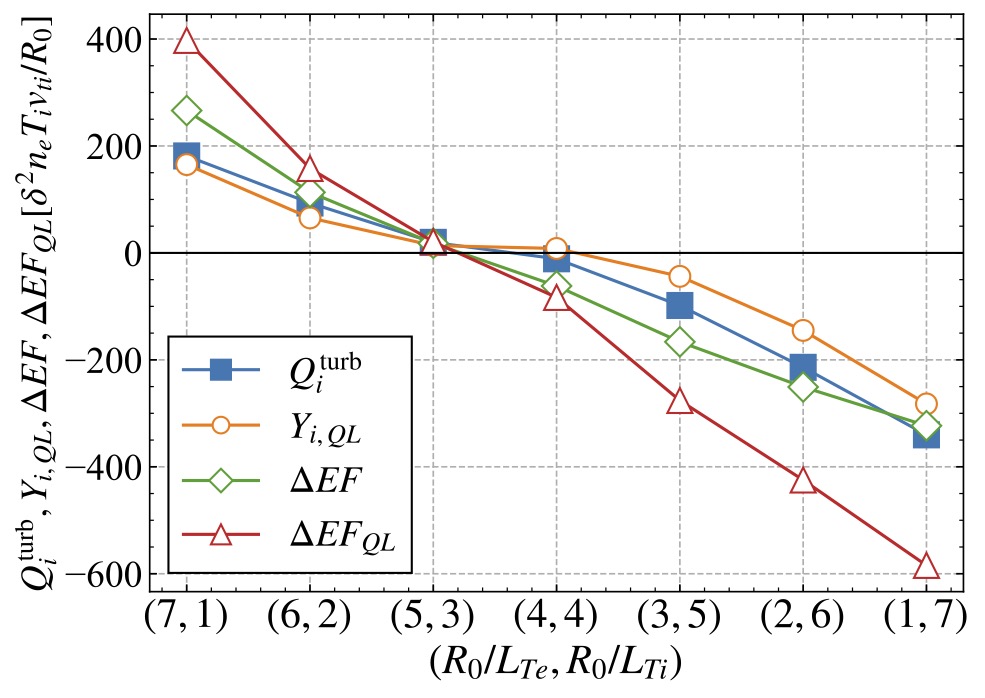
In this study, the energy exchange between electrons and ions in trapped-electron-mode (TEM) and mixed ion temperature gradient (ITG)–TEM turbulence is investigated using gyrokinetic simulations. The energy exchange in TEM turbulence is primarily composed of the cooling of electrons associated with perpendicular grad-B curvature drift and the heating of ions moving parallel to magnetic field lines. TEM turbulence facilitates energy transfer from electrons to ions, which is opposite to the direction observed in ITG turbulence. In mixed ITG–TEM turbulence, the relative magnitudes of parallel heating and perpendicular cooling for each species determine the overall direction and magnitude of energy exchange. From the viewpoint of entropy balance, it is further confirmed that energy flows from the species with larger entropy production, caused by particle and heat fluxes, to the other species in ITG–TEM turbulence. The predictability of turbulent energy exchange in ITG–TEM turbulence by the quasilinear model is examined. In addition, an alternative method based on the correlation between energy flux and energy exchange is developed, and its validity is demonstrated.
The numerical simulations were performed on Plasma Simulator of NIFS.
【Information】
T. Kato, H. Sugama, and T.-H. Watanabe, “Energy exchange between electrons and ions driven by ITG-TEM turbulence,” Phys. Plasmas 32, 122303 (2025).
DOI: 10.1063/5.0291372